
stele1
stele1 is a stable format for climbing data:
organize an area you know well into an accessible catalog.
That catalog lives on your computer as a folder.
Whatever you build from it — a guidebook, a website, or a folder you share — is your choice.
the editor
The editor runs in your browser.
No account needed; accounts aren't even available.
The editor updates your catalog directly.
No admin approval needed; administrators don't even exist.
The editor covers the whole spec; everything in the spec is editable. Plus some utilities: whole-area map and search, dedicated pages for each route, area, and photo.
the schema & format
The schema is a set of small, intentional choices about how to model climbing.
Climb Notes are flexible and organized by topic.
...
"notes": [
  {"topic":   "history",
   "content": "Alan Watts bolted it, ground-up on lead in 1985. Despite the respectable style by modern standards, it caused moderate uproar at the time.  Watts projected it himself but didn't send. Jean-Baptiste Tribout, visiting from France in 1986, sent it, calling it 5.14a. The first 5.14 in America. The next few years brought ascents from the whos-who of late 80s climbers: Scott Franklin, Jerry Moffatt, Ron Kauk. Alan Watts came back in '89 for his own ascent. Since then, we've seen it go from a route for the elite to impressive goal for some of the most talented amateurs."},
  {"topic":   "elevator pitch",
   "content": "The name asks: should bolts like this exist? load up on quickdraws and find out!"},
  {"topic":   "beta",
   "content": "The first 1/3 is a warm-up of crimps and stems to a no-hands at the third bolt. The crux is the next 25 feet: small crimps and side pulls on a slight overhang, no real rests, exit on a long lock-off to a sidepull rail. Above the crux, a knee-bar rest if you weight it right. The headwall is 5.12+ on big holds."},
  {"topic":   "locating",
   "content": "Begins from above a pointed boulder. Right of the arete two small roofs (Last Waltz), left of Sunshine Dihedral."}
],
...
Each climb can carry a comprehensive selection and particular notes can be extracted when publishing.
A rating can be just the difficulty (from any scale you want to use).
{"difficulty": "5.8+"}Often, just difficulty isn't a full picture, so style and protection are supported.
{
  "difficulty": "5.10",
  "style":      "trad",
  "protection": "PG"
}
Photos have climb layers and area layers for drawing on photos. Origin is at the top-left corner, and points are fractional offsets that easily map to thumbnails as well as the original image.
Climbs are a simple path.
[
  { "climb_uuid": "fc67fb9f-acae-4ac4-afbc-f7227af9a287",
    "path": [{ "left_offset": 0.58359, "top_offset": 0.48041 },
             { "left_offset": 0.53799, "top_offset": 0.1947  }] },
  { "climb_uuid": "d1d596d4-c818-4e64-a648-3656c968f175",
    "path": [{ "left_offset": 0.66109, "top_offset": 0.45407 },
             { "left_offset": 0.63678, "top_offset": 0.38112 },
             { "left_offset": 0.57447, "top_offset": 0.26765 },
             { "left_offset": 0.53647, "top_offset": 0.1947  }] }
]
Areas are a ring (note that the first and last points are identical).
[
  {
    "area_uuid": "fcbb20b7-064d-4957-92a7-ce8cbe41e0c1",
    "polygon": [{ "left_offset": 0.23503, "top_offset": 0.78014 },
                { "left_offset": 0.24805, "top_offset": 0.2472  },
                { "left_offset": 0.6947,  "top_offset": 0.0996  },
                { "left_offset": 0.8314,  "top_offset": 0.6881  },
                { "left_offset": 0.23503, "top_offset": 0.78014 } ]
  }
]
A catalog is a straightforward layout of JSON files and images.
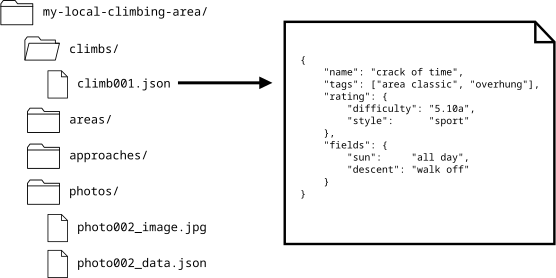
This strikes a useful balance between structure and accessibility.
The format is portable, transparent, and built to outlast any single tool.
what stele1 is for
stele1 is designed for outdoor free climbing. The design intentions start and stop at outdoor free climbing. Utility for gyms, big-walls, indoor competitions, and mountaineering is incidental.
A stele1 catalog covers an area that someone can know well. You can fully know Devils Lake, Shagg Crag, or HP40. A subset of a larger destination is also a good fit: Joshua Tree Boulders or The New's Endless Wall. A single catalog for a huge region like Appalachia, the Sierras, or Colorado would be working against the grain.
What you know well is what sets the scope of your catalog.
stele1 as a data layer
The 1 in stele1 is a compatibility commitment. Any stele1 catalog will always load in stele1 tools.
JavaScript and Python libraries read and write catalogs. A Python CLI covers exploring and prototyping from the shell.
 stele1-datatypes
- stele1-filesystem
 @stele-climbing/stele1-datatypes
- @stele-climbing/stele1-filesystem
- @stele-climbing/stele1-directory-handle
 stele1.sh
The format and libraries are a foundation that won't move, so you can build your own climbing software without rehashing the basics.